
Ensuring cancer trials deliver outcomes that matter most: living longer and living better.
Why is this needed?
Randomized clinical trials (RCTs) are the gold standard for evaluating cancer treatments and for determining changes to standard of care. However, some cancer RCTs have been criticized for focusing on regulatory approval more than the outcomes that matter most to people with cancer.
In order to ensure treatments truly meet patients’ needs, RCTs should center the voices and values of cancer patients at all stages of design, conduct, and reporting. Doing so helps ensure that treatments result in meaningful benefits for the patient, such as prolonged survival and improved quality of life.
The Common Sense Oncology Values-to-Action Framework for Cancer Clinical Trials is about ensuring that cancer trials deliver outcomes that matter most to patients, including living longer and living better.
How can we design the best possible patient-centred clinical trials?
This values-to-action framework offers a pragmatic, values-based tool to support patient-centred research designs. It is intended to be used by trialists, ethics boards, funders, patient organizations, and others who may help to shape cancer clinical trial design and reporting. The framework was developed through extensive engagement with people with lived experience of cancer.
Take Action
Are you an Advocate, Trialist, IRB, Funder, or Regulator? You can drive change.
Read the full paper in JNCI Download the Infographic Have Questions? Contact Us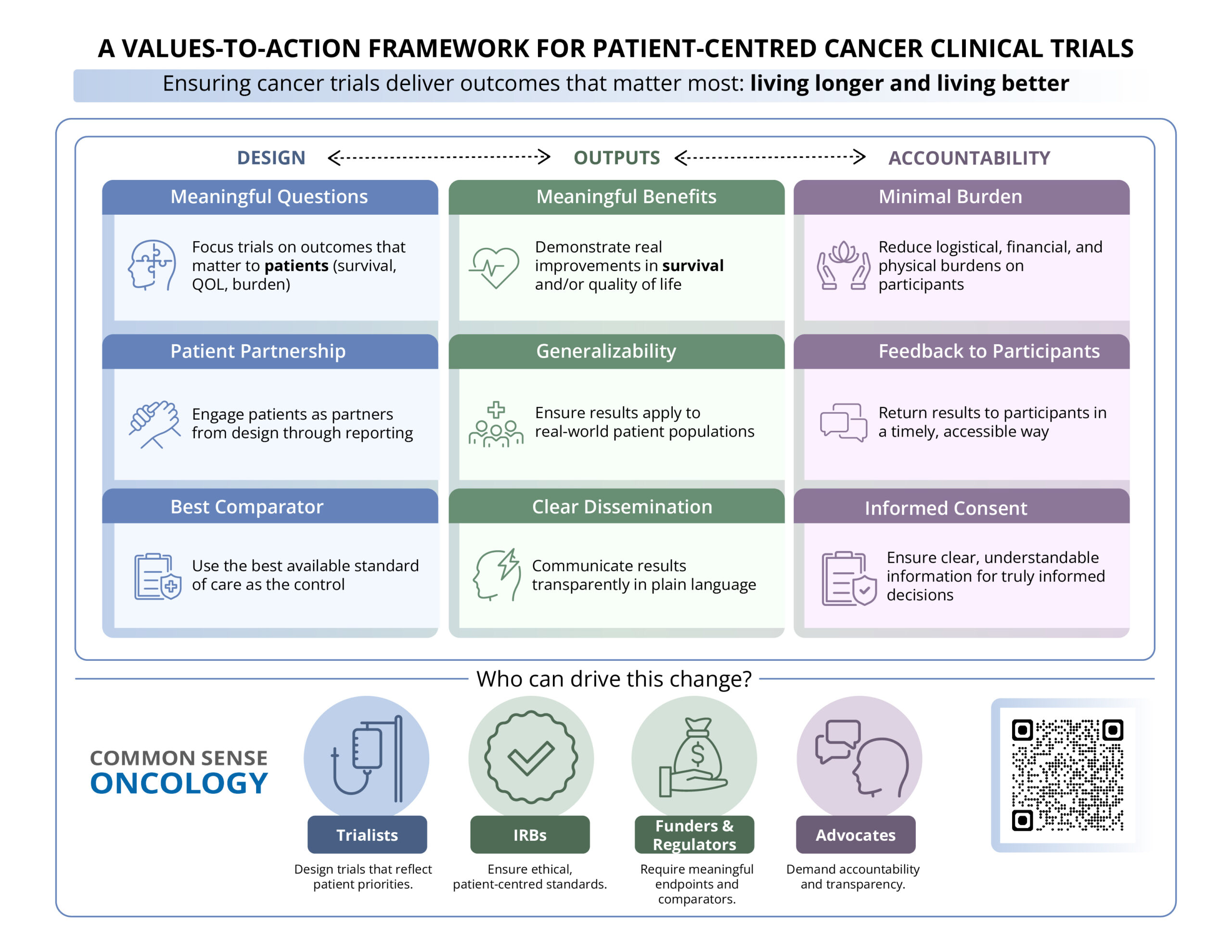
Three Pillars of the Framework
Design

Meaningful Questions
Focus trials on outcomes that matter to patients (survival, quality of life, burden).

Patient Partnership
Engage patients as partners from design through reporting.

Best Comparator
Use the best available standard of care as the control.
Applicability

Meaningful Benefits
Demonstrate real improvements in survival and/or quality of life.

Generalizability
Ensure results apply to real-world patient populations.

Clear Dissemination
Communicate results transparently in plain language.
Accountability

Minimal Burden
Reduce logistical, financial, and physical burdens on participants.

Feedback to Participants
Return results to participants in a timely, accessible way.

Informed Consent
Ensure clear, understandable information for truly informed decisions.
How was it developed, and who developed it?
The Values-to-Action framework is grounded in global patient input.
In Phase 1, the foundational research was developed with a scoping review of literature, patient rights charters, and existing frameworks. A thematic synthesis was developed into a draft framework.
Phase 2 kicked off with a pilot focus group in New Zealand, followed by seven international focus groups across multiple countries. These focus sessions were accompanied by a pre-session survey encompassing 9-point importance ratings and free text. In all, 72 participants–survivors, people living with metastatic cancer, family members, and advocates–from the U.S., Canada, India, Brazil, South Africa, Ghana, Kenya, Nigeria, and Europe contributed to this research.
The Values-to-Action Framework was finalized in Phase 3 using descriptive and nonparametric analysis, iterative qualitative coding, and framework refinement.
Who can drive this change?

Trialists

IRBs

Funders & Regulators

Advocates
- Trialists
- Design trials that reflect patient priorities.
- IRBs
- Ensure ethical, patient-centred standards.
- Funders & Regulators
- Require meaningful endpoints and comparators.
- Advocates
- Demand accountability and transparency.
- Use the framework when reviewing clinical trials.
How will CSO build on this framework?
- The framework will be integrated into CSO educational modules and collaborations.